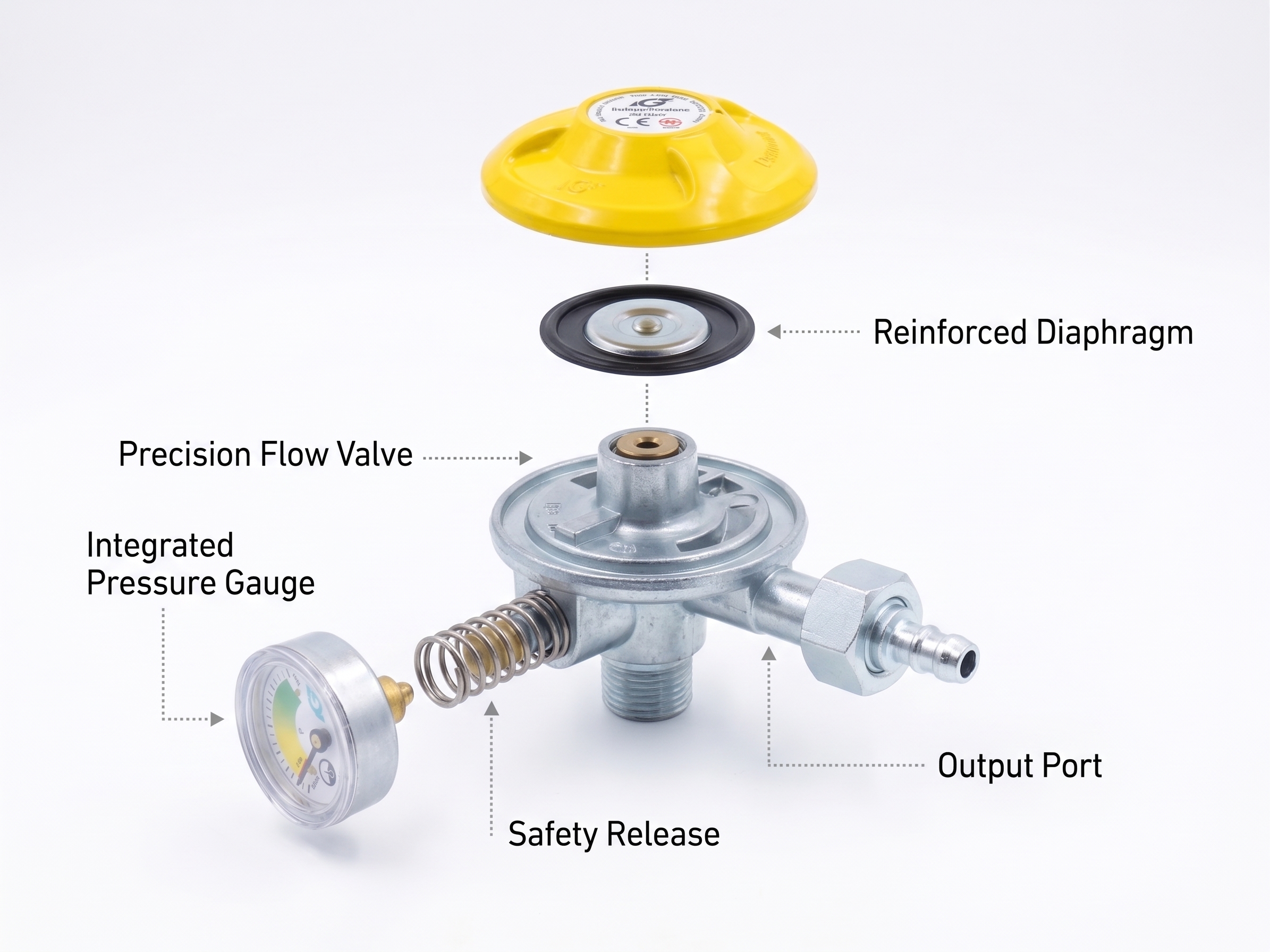
Every gas regulator sold in Nepal does one basic job: it reduces the high pressure inside your LPG cylinder to a low, steady pressure suitable for your stove burner. The IGT gas regulator does this too — but it adds a critical second function that ordinary regulators completely lack. It monitors gas flow in real time and automatically shuts off gas supply the instant something goes wrong.
This is not a marketing claim. It is a mechanical engineering feature built into the regulator body. In this guide, we explain exactly how the IGT automatic excess-flow shut-off valve works, why ordinary regulators cannot do this, and what happens inside the regulator during a hose rupture or disconnection.
What Is Excess-Flow Shut-Off Technology?
Excess-flow shut-off is a safety mechanism that detects abnormally high gas flow rates and automatically blocks gas from flowing. In the IGT regulator, this is achieved through a spring-loaded internal valve positioned in the gas flow path between the cylinder connection and the outlet to your hose.
Under normal cooking conditions, gas flows from the cylinder through the regulator at a controlled rate — just enough to feed your stove burner. The spring-loaded valve stays open because the gas flow rate is within the expected range. You cook normally, boil water, fry food — everything works exactly like any other regulator.
But the moment the gas flow rate spikes beyond normal — which happens instantly when a hose breaks, pulls off the stove, gets chewed through by a rodent, or disconnects from the regulator — the excess-flow valve detects this surge and snaps shut. Gas flow stops completely in under 0.1 seconds.
This is faster than any human reaction. By the time you hear a hose pop or notice something wrong, the IGT regulator has already blocked the gas. No LPG escapes into the room, no gas cloud builds up, and there is no fire or explosion risk.
Why Ordinary Regulators Cannot Do This
A standard gas regulator sold at hardware shops across Kathmandu, Pokhara, and every other city in Nepal contains only a pressure-reduction mechanism. It uses a diaphragm and spring to reduce the cylinder's internal pressure (around 6–8 bar) down to the burner-safe pressure (around 29 mbar).
This pressure regulation works perfectly during normal cooking. But here is the critical gap: if the hose between the regulator and the stove breaks, disconnects, or develops a large crack, the regulator treats this as normal demand. The open end of the broken hose has zero resistance, so gas flows at maximum rate — but the ordinary regulator has no mechanism to detect this. It keeps supplying gas at full flow because, from the regulator's perspective, it is just meeting demand.
The result: LPG pours out of the broken hose into the kitchen. LPG is heavier than air, so it settles at floor level and accumulates. Within minutes, the gas concentration can reach explosive levels. A single spark — from a light switch, a phone notification, static electricity, or a match — triggers an explosion or fire.
The IGT regulator eliminates this scenario entirely because it has a second independent mechanism — the excess-flow valve — that the ordinary regulator simply does not have.
Step-by-Step: What Happens During a Hose Rupture
Let us walk through exactly what happens inside the IGT regulator when a hose breaks while you are cooking:
Step 1: The hose breaks. Whether it cracks from age, gets pulled off the stove connection, or is damaged by a rodent bite, the hose line suddenly has a large open gap. Gas rushes toward this gap because there is no longer any resistance from the stove burner.
Step 2: Flow rate spikes. Inside the regulator, the gas flow rate jumps dramatically — far beyond what any stove burner would ever demand. This spike happens within milliseconds.
Step 3: The excess-flow valve activates. The spring-loaded valve inside the IGT regulator is calibrated to allow normal cooking flow rates but to trip (snap shut) when flow exceeds the safe threshold. The sudden spike triggers this mechanism. The valve closes and physically blocks the gas path.
Step 4: Gas stops flowing. In under 0.1 seconds from the moment the hose broke, gas flow has been cut to zero. No LPG reaches the broken hose end. No gas enters the room.
Step 5: The regulator locks. The IGT regulator stays in the locked (shut-off) position. It will not allow gas to flow again until you manually reset it by pressing the bottom-reset safety pin. This is a deliberate design choice — it forces you to inspect the setup and identify what caused the shut-off before gas can flow again.
The Bottom-Reset Safety Pin: Why It Matters
After the excess-flow valve triggers, the IGT regulator does not automatically resume gas flow. You must physically press the reset pin located at the bottom of the regulator body. This requires intentional action — you cannot accidentally reset it, and a child cannot easily reach or operate it.
The reset sequence is simple: inspect your hose and connections to identify the problem, fix the issue (replace the hose, reattach the connection, tighten the clamp), and then press the reset pin to restore gas flow. This ensures that gas only flows again after the cause of the emergency has been addressed.
The Built-In Manometer: Your 2-Minute Leak Test Tool
The IGT gas regulator (Model A126i-M003) includes a calibrated manometer — a pressure gauge mounted on the regulator body. This gauge serves two critical functions:
Leak detection: After connecting the regulator to your gas cylinder, close all stove valves so no gas is flowing. The manometer needle should settle at a reading and stay perfectly still. If the needle slowly drops over the next two minutes, it means gas is escaping somewhere in the line — a loose connection, a pinhole in the hose, or a leaking stove valve. You have identified a leak without soap water, without a technician, and without guesswork. Read our complete manometer guide for detailed instructions.
Gas reserve level: The gauge also indicates your cylinder's remaining gas level. When the needle enters the yellow zone, your cylinder is running low and it is time to arrange a refill. This prevents the inconvenience of running out mid-cooking — especially useful during busy festival periods like Dashain and Tihar.
Technical Specifications of the IGT A126i-M003
Here are the key technical details of the IGT gas regulator sold in Nepal:
- Model: IGT Denmark Type A126i-M003
- Certification: EN 16129 (European safety standard for LPG regulators with integrated safety devices)
- Shut-off response time: Less than 0.1 seconds on excess flow detection
- Connection type: 25.6mm compact snap-on collar (fits Nepal NS-530 standard cylinders)
- Manometer range: 0–10 bar, calibrated for leak detection and gas level indication
- Reset mechanism: Bottom-mounted safety pin (manual press to restore gas flow)
- Compatible cylinders: All standard 14.2 kg domestic LPG cylinders in Nepal — Nepal Gas, Siddhartha, Everest, Sugam, Surya, Baba, and 35+ other brands
- Warranty: 2-year full replacement warranty, valid across all 77 districts of Nepal
- Origin: Denmark — every unit has embossed "IGT" branding and laser-engraved serial number
Real-World Scenarios Where IGT Protection Activates
The excess-flow shut-off valve activates in any situation where gas flow suddenly exceeds normal levels. Here are the most common real-world triggers:
- Hose pulled off the stove: A child pulls the gas hose, a heavy pot pushes it, or someone trips over it. The hose disconnects from the stove burner. IGT shuts off gas instantly.
- Rubber hose cracks: Years of heat exposure, drying, and bending cause the rubber hose to crack. When the crack opens wide enough, gas rushes out. IGT detects the surge and locks.
- Rodent damage: Rats and mice chew through rubber hoses, especially at night when the kitchen is quiet. When the hole gets large enough to cause abnormal flow, IGT shuts off.
- Regulator-hose disconnection: During cylinder swaps, if the hose is not properly secured, it can slip off the regulator outlet. IGT catches this immediately.
- Jubilee clip failure: Rusty or loose metal clamps give way under pressure. The hose slips off. IGT stops gas before it escapes.
How to Install the IGT Regulator
Installation takes less than 60 seconds and requires no tools. Snap the regulator onto your gas cylinder valve (25.6mm click-on fitting), connect your hose to the regulator outlet, secure with the provided clamps, and open the cylinder valve. That is it. For detailed step-by-step instructions with photos, read our IGT installation guide.
Frequently Asked Questions
Does the IGT regulator work like a normal regulator for everyday cooking?
Yes. During normal cooking, the IGT regulator functions identically to any other gas regulator. Gas flows normally to your stove. The excess-flow shut-off valve only activates when it detects abnormally high gas flow — which only happens during a hose break or disconnection.
How fast does the automatic shut-off activate?
The excess-flow valve closes in under 0.1 seconds. This is faster than human reaction time. By the time you notice something is wrong, the regulator has already stopped gas flow completely.
What do I do after the regulator shuts off automatically?
Inspect your hose and all connections to find what caused the abnormal flow. Fix the issue — replace the hose, reattach the connection, or tighten the clamp. Then press the bottom-reset safety pin on the regulator to restore gas flow. Never reset without inspecting first.
Can I test the shut-off mechanism at home?
We do not recommend deliberately triggering the excess-flow valve at home as it requires disconnecting the hose while gas is flowing. You can verify your regulator is working correctly by using the manometer leak test instead — this confirms the entire system is sealed and the regulator is functioning normally.
Ready to upgrade? Order the IGT gas regulator from our official store with free Kathmandu Valley delivery and a 2-year full replacement warranty.