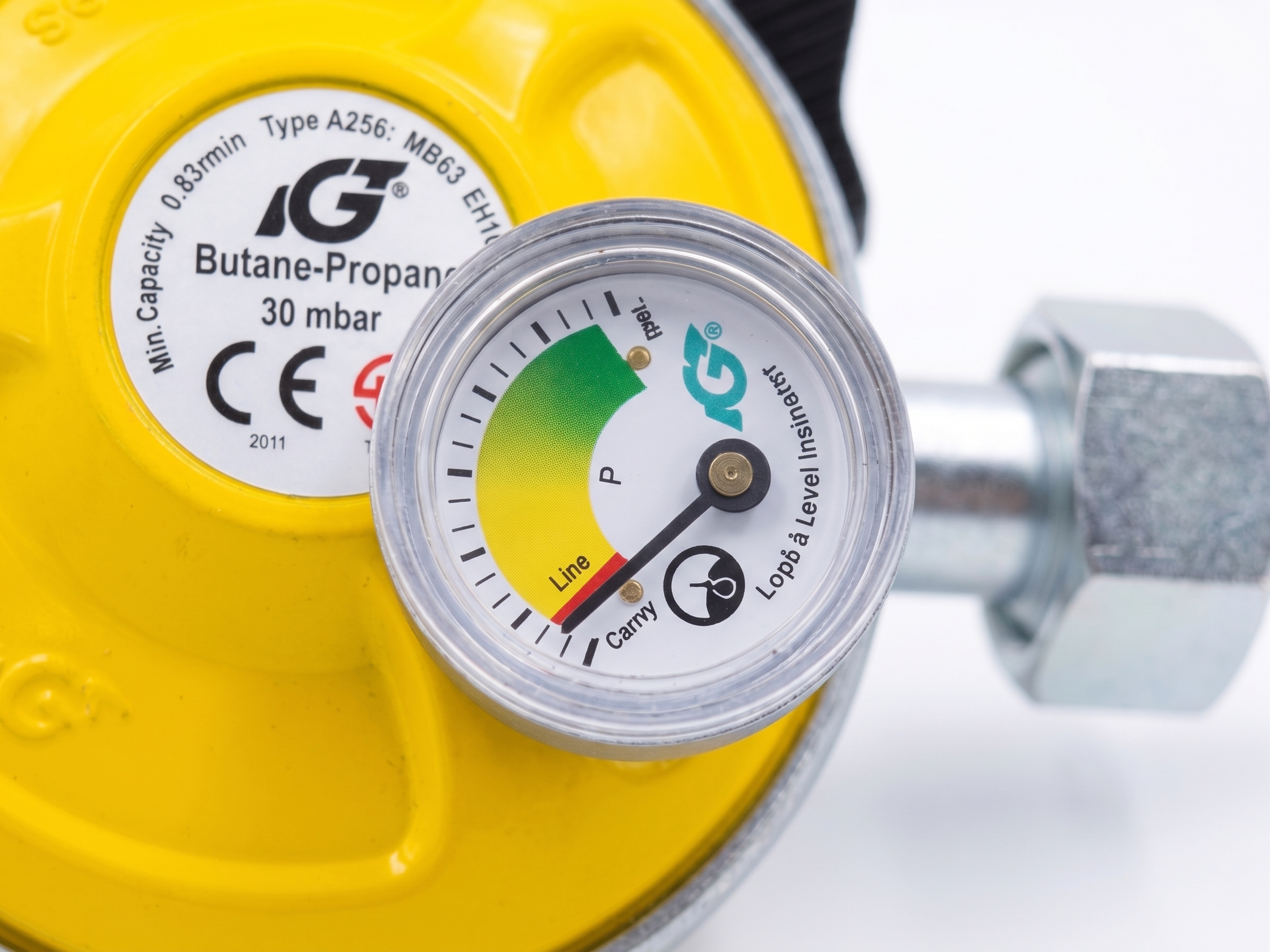
The IGT gas regulator (Model A126i-M003) includes a built-in manometer — a calibrated pressure gauge mounted directly on the regulator body. This is not just a decorative dial. It is a practical safety tool that lets you test your entire gas system for leaks in two minutes and check your cylinder's remaining gas level at a glance — without soap water, without a technician, and without guesswork.
Most gas regulators sold in Nepal do not have a manometer. They give you no way to know if your system is airtight or if your cylinder is running low until you run out mid-cooking. The IGT manometer solves both problems.
What the Manometer Shows You
The manometer dial displays the pressure in your gas system. It has three colour-coded zones:
- Green zone — the system is properly pressurized and operating normally. Your gas level is adequate and your connections are sealed.
- Yellow zone — your gas cylinder is getting low. The remaining gas is entering reserve levels. This is your signal to arrange a refill or swap cylinder before you run out during cooking.
- Red zone — the cylinder is nearly empty, or there may be a significant pressure issue in the system. Replace the cylinder.
During normal cooking, the needle position fluctuates slightly as gas flows to the burner. This is normal. The important readings are taken with all stove valves closed (for leak testing) or before you start cooking (for gas level checking).
How to Run a 2-Minute Leak Test
This is the most valuable function of the manometer. It tests every connection point in your gas system simultaneously — regulator-to-cylinder, hose-to-regulator, hose-to-stove, and stove valve seats — in a single two-minute test.
Step 1: Make sure all stove burner valves are in the OFF position. No gas should be flowing through the system.
Step 2: Connect the IGT regulator to your gas cylinder. Open the cylinder valve slowly. Gas will fill the line and pressurize the system.
Step 3: Watch the manometer needle. It will rise and settle at a reading once the system is fully pressurized.
Step 4: Wait two minutes. Do not touch anything. Just watch the needle.
Result A — Needle holds perfectly steady: Your entire gas system is airtight. There are no leaks at any connection point. You are safe to cook.
Result B — Needle drops slowly: Gas is escaping somewhere in the system. There is a leak. The rate of the needle drop indicates the severity — a fast drop means a significant leak, a slow drop means a small, slow leak.
If the needle drops, close the cylinder valve and identify the leak. Check each connection point by applying soap water — bubbles will form at the leaking joint. Tighten clamps, replace washers, or replace the hose as needed. Then run the manometer test again to confirm the fix.
Using the Manometer to Check Gas Level
The manometer also gives you an approximate indication of your cylinder's remaining gas level. This is most accurate when you check the gauge with all stove valves closed and the system at rest (no gas flowing).
- Needle well into the green zone: The cylinder has plenty of gas remaining. No action needed.
- Needle approaching the yellow zone: The cylinder is getting low. Start planning to get a refill. In Nepal, you can check the current NOC price on our daily LPG gas price checker before ordering.
- Needle in the yellow zone: Gas is running low. You may experience reduced flame strength during heavy cooking. Swap the cylinder soon.
- Needle in the red zone: The cylinder is nearly empty. Replace it before your next cooking session.
Note that the gas level reading is approximate — it is based on system pressure, which is affected by ambient temperature. On hot days, the needle may read slightly higher than reality. On cold winter days, it may read slightly lower. Despite this, it is far more useful than having no indication at all, which is what you get with a standard regulator.
Manometer vs Soap Water Testing: Why the Manometer Wins
The traditional soap water method has been used in Nepal for decades. It works — but it has significant limitations compared to the manometer test:
| Factor | Soap Water Test | Manometer Test |
|---|---|---|
| Tests entire system at once | ❌ Tests one joint at a time | ✅ Tests all connections simultaneously |
| Time required | 5–10 minutes | 2 minutes |
| Detects very small leaks | May miss slow leaks | ✅ Needle drop visible even for tiny leaks |
| Mess | Soapy water everywhere | ✅ No mess |
| Materials needed | Soap, water, brush | ✅ Nothing — built into regulator |
| Checks stove valve seats | ❌ Not easily | ✅ Included in system test |
| Gas level indication | ❌ No | ✅ Approximate level shown |
The manometer does not completely replace the soap water test — if you find a leak with the manometer, you still need soap water (or visual inspection) to identify exactly which joint is leaking. But as a first-line screening tool, the manometer is faster, easier, cleaner, and more thorough.
Common Manometer Questions Answered
The manometer needle bounces or fluctuates while cooking — is this normal?
Yes. When gas is flowing to the burner, the system pressure varies slightly. Small fluctuations during cooking are completely normal. The steady reading for leak testing should only be taken with all stove valves closed.
The needle does not return to zero when the cylinder is disconnected — is it broken?
Some residual pressure may remain in the system even after disconnecting the cylinder, keeping the needle slightly above zero. This is normal and does not indicate a defect. The needle will drop to zero once the residual gas dissipates.
Can I buy a separate manometer and add it to my standard regulator?
Standalone manometer gauges exist, but they require compatible fittings and proper installation. The IGT regulator's manometer is factory-integrated and calibrated — it is the simplest and most reliable way to get manometer functionality in Nepal.
How accurate is the gas level indication?
The gas level reading is approximate, not precise. It is based on system pressure, which is influenced by temperature and gas composition. Treat it as a useful indicator — when the needle approaches yellow, your gas is getting low. Do not rely on it as a precise fuel gauge.
Does the manometer need calibration or maintenance?
The manometer is a sealed, factory-calibrated unit. It does not require user calibration or maintenance. If the gauge glass cracks or the needle becomes stuck, contact IGT Nepal support for warranty replacement.