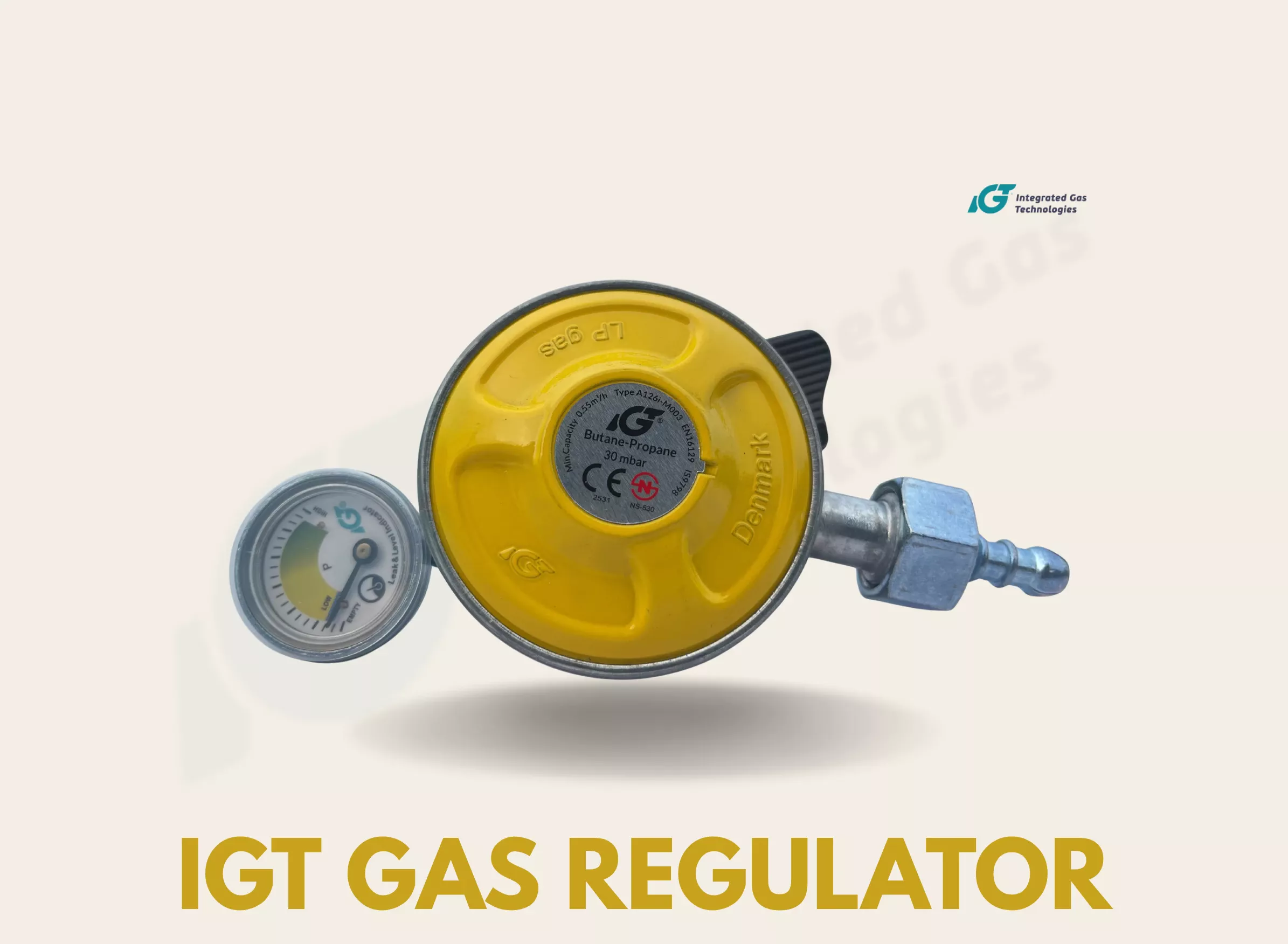
Choosing a gas regulator in Nepal is not just about price. The regulator sitting on top of your LPG cylinder is the only device standing between your family and a potential gas fire. Yet most households buy whatever regulator is cheapest or whatever the gas delivery person hands them — without understanding what it can and cannot do.
This guide compares the two types of gas regulators available in Nepal: standard pressure-control regulators and the Danish IGT automatic excess-flow shut-off regulator. We look at safety features, build quality, certifications, warranty, and value for money so you can make an informed decision.
Understanding Gas Regulators: What Every Nepal Household Should Know
A gas regulator is a pressure-reduction device. Inside your LPG cylinder, gas is stored at high pressure — typically 6 to 8 bar. Your stove burner needs gas at about 29 millibar. The regulator sits between the cylinder and your hose, reducing this pressure to a safe, usable level.
Every gas regulator in Nepal does this basic job. The difference between regulators is what else they do — or fail to do — when something goes wrong.
Standard Regulators Sold in Nepal: What You Get
Walk into any hardware shop in Kathmandu, Pokhara, or Biratnagar and you will find standard gas regulators priced between Rs. 200 and Rs. 600. These are mass-produced pressure regulators — usually made in India or China — that use a simple diaphragm-and-spring mechanism to reduce gas pressure.
Here is what a standard regulator provides:
- Pressure reduction from cylinder pressure to burner-safe pressure
- Basic valve mechanism to start and stop gas flow manually
- Clip-on or screw-on connection to the cylinder valve
And here is what a standard regulator does not provide:
- No automatic shut-off during hose rupture or disconnection
- No excess-flow detection of any kind
- No built-in pressure gauge for leak testing
- No gas reserve level indicator
- No European or international safety certification
- No meaningful warranty — most have zero or 6-month coverage
This means that if your rubber hose cracks, gets pulled off, or is chewed through by a rodent while connected to a standard regulator, gas keeps flowing at full rate into your kitchen. The regulator cannot detect or respond to this — it was never designed to.
The Danish IGT Gas Regulator: What Makes It Different
The IGT gas regulator (Model A126i-M003) is manufactured by Integrated Gas Technologies in Denmark. It is not just a pressure-reduction device — it is a pressure-reduction device with an integrated excess-flow safety valve and a built-in manometer pressure gauge.
Here is what the IGT regulator provides:
- Pressure reduction — same basic function as any regulator, reducing cylinder pressure to burner-safe levels
- Automatic excess-flow shut-off — a spring-loaded internal valve that detects abnormally high gas flow (caused by hose breaks or disconnections) and slams shut in under 0.1 seconds, cutting gas completely
- Built-in manometer — a calibrated 0–10 bar pressure gauge for 2-minute leak testing without soap water, plus gas reserve level indication (yellow zone = low gas)
- Bottom-reset safety pin — after an automatic shut-off, gas only resumes when you manually press the reset pin, forcing you to inspect and fix the issue first
- EN 16129 certification — tested and certified under the European safety standard for LPG regulators with integrated safety devices
- Universal 25.6mm snap-on collar — fits all standard Nepal domestic cylinders including Nepal Gas, Siddhartha, Everest, Sugam, Surya, Baba, and 35+ other brands
- 2-year full replacement warranty — valid across all 77 districts of Nepal
Feature-by-Feature Comparison
| Feature | Standard Regulator | IGT A126i-M003 |
|---|---|---|
| Pressure reduction | ✅ Yes | ✅ Yes |
| Automatic shut-off on hose break | ❌ No | ✅ Under 0.1 seconds |
| Excess-flow detection | ❌ No | ✅ Built-in valve |
| Manometer (pressure gauge) | ❌ No | ✅ 0–10 bar calibrated |
| Leak test capability | ❌ Soap water only | ✅ 2-minute gauge test |
| Gas reserve indicator | ❌ No | ✅ Yellow zone warning |
| Safety certification | ❌ None or unverified | ✅ EN 16129 (European) |
| Warranty | None or 6 months | 2 years full replacement |
| Cylinder compatibility (Nepal) | Varies by brand | 35+ brands confirmed |
| Reset mechanism | N/A | Bottom-reset safety pin |
| Country of manufacture | India/China (varies) | Denmark |
The Safety Gap: What Happens During a Hose Failure
The most dangerous situation in any LPG kitchen is a hose failure — the rubber pipe cracks, pulls off the stove, or is damaged by rodents. Let us compare what happens with each regulator type:
With a standard regulator: Gas continues flowing at maximum rate through the broken hose. LPG is heavier than air, so it settles at floor level and accumulates. Within minutes, the kitchen fills with an invisible, explosive gas cloud. Any spark — from a light switch, phone, or match — can cause an explosion or fire. The regulator has no mechanism to detect or prevent this.
With the IGT regulator: The excess-flow valve detects the sudden spike in gas flow caused by the broken hose. In under 0.1 seconds, the valve slams shut and gas flow stops completely. No gas reaches the broken hose end. No gas cloud forms. The regulator stays locked until you manually press the bottom reset pin after inspecting and fixing the problem.
This is not a theoretical difference. It is the difference between a normal day and a kitchen fire. For a detailed technical breakdown, read our guide on how IGT automatic gas shut-off works.
Who Should Upgrade to the IGT Regulator?
The short answer: any household or business that uses LPG gas in Nepal. But some situations make the upgrade especially critical:
- Families with young children — children pull hoses, bump into cylinders, and are most vulnerable to gas exposure
- Houses with old or cracked rubber hoses — the automatic shut-off protects you even if the hose fails unexpectedly
- Areas with rodent problems — rats and mice chew through rubber hoses at night; IGT shuts off gas before the leak becomes dangerous
- Rental properties — landlords can provide a safer kitchen environment for tenants
- Elderly or single-person households — people who may not react quickly to a gas emergency
- Festival and party cooking — crowded kitchens during Dashain, Tihar, and weddings where chaos increases accident risk
- Commercial kitchens — restaurants, hotels, and catering operations where continuous cooking and multiple burners raise risk levels
How to Verify You Are Getting a Genuine IGT Regulator
Counterfeit gas regulators are a real problem in Nepal. Some sellers market cheap regulators as "auto-cut" or "safety" regulators without any actual excess-flow mechanism. Here is how to verify authenticity:
- Embossed "IGT" branding on the regulator body
- Model type "A126i" engraved on the unit
- Hologram seal on the packaging
- Laser-engraved serial number unique to each unit
- Purchased from the official IGT Nepal store or authorized dealers
For a complete verification guide with photos, read our article on how to identify genuine Danish IGT regulators.
Frequently Asked Questions
Is the IGT regulator worth the higher price compared to standard regulators?
Yes. A standard regulator costs Rs. 200–600 but provides zero protection during a hose failure. The IGT regulator is a one-time purchase that protects your family for years with automatic shut-off, leak testing, and a 2-year warranty. Read our detailed cost-benefit analysis.
Can I use the IGT regulator with my existing gas hose?
Yes, the IGT regulator outlet fits standard gas hoses used in Nepal. However, we recommend pairing it with a certified flame-retardant safety hose for maximum protection — available in our Complete Safety Kit.
How long does the IGT regulator last?
The IGT regulator is built to last well beyond the 2-year warranty period. International safety standards recommend replacing any gas regulator every 5–10 years. The manometer and excess-flow valve are mechanical components designed for long-term reliability.
Does the IGT regulator slow down cooking or reduce flame strength?
No. During normal cooking, the IGT regulator delivers gas at the same pressure and flow rate as any standard regulator. Your stove will perform identically. The excess-flow valve only activates during abnormal flow conditions.
Ready to upgrade your kitchen safety? Order the IGT gas regulator with free Kathmandu Valley delivery and Cash on Delivery across all 77 districts.