If you smell gas in your kitchen right now, stop reading and act. Do not touch any electrical switches. Do not light a match. Open every window and door, close the cylinder valve, get everyone out of the house, and call for help from outside. Come back to this guide later.
For everyone else: this guide teaches you the exact 7-step emergency procedure that every person in Nepal should know before they ever encounter a gas leak. Knowing what to do — and what absolutely not to do — can mean the difference between a minor scare and a devastating fire or explosion.
Step 1: Do Not Touch Any Electrical Switches
This is the most important and most counter-intuitive step. When people smell gas, the instinct is to turn on the light to see better, or turn on the exhaust fan to clear the air. Do NOT do this.
Every electrical switch — light switches, fan switches, AC controls, even phone chargers — can produce a tiny spark when toggled. This spark is invisible to the naked eye but is more than enough to ignite a gas-air mixture. A single flip of a light switch in a gas-filled room can trigger an explosion.
If lights are already on, leave them on. If they are off, leave them off. Do not touch any electrical device.
Step 2: Do Not Use Your Phone Inside the Room
Mobile phones can produce small electrical discharges during calls, notifications, or screen activation. While the risk is low, it is not zero — and in a room with accumulated LPG gas, "low risk" is not acceptable.
Do not make calls, do not take photos, do not check messages. Take your phone and leave the room. Make calls from outside the building, at least 10 metres from the gas source.
Step 3: Open All Doors and Windows Immediately
LPG is 1.5 times heavier than air. It does not rise and escape through ventilation — it settles at floor level and accumulates in the lowest points of the room. The only way to dissipate it is to create a cross-ventilation path that allows fresh air to push the gas out.
Open every door and window in the kitchen and adjacent rooms. If there are doors to the outside, open them wide. Do not use electric fans to help — remember Step 1. Let natural air movement do the work.
Step 4: Close the Cylinder Valve
Walk to the gas cylinder and close the valve by turning the handle fully clockwise. This stops gas supply at the source. If the regulator has a separate valve, close that too.
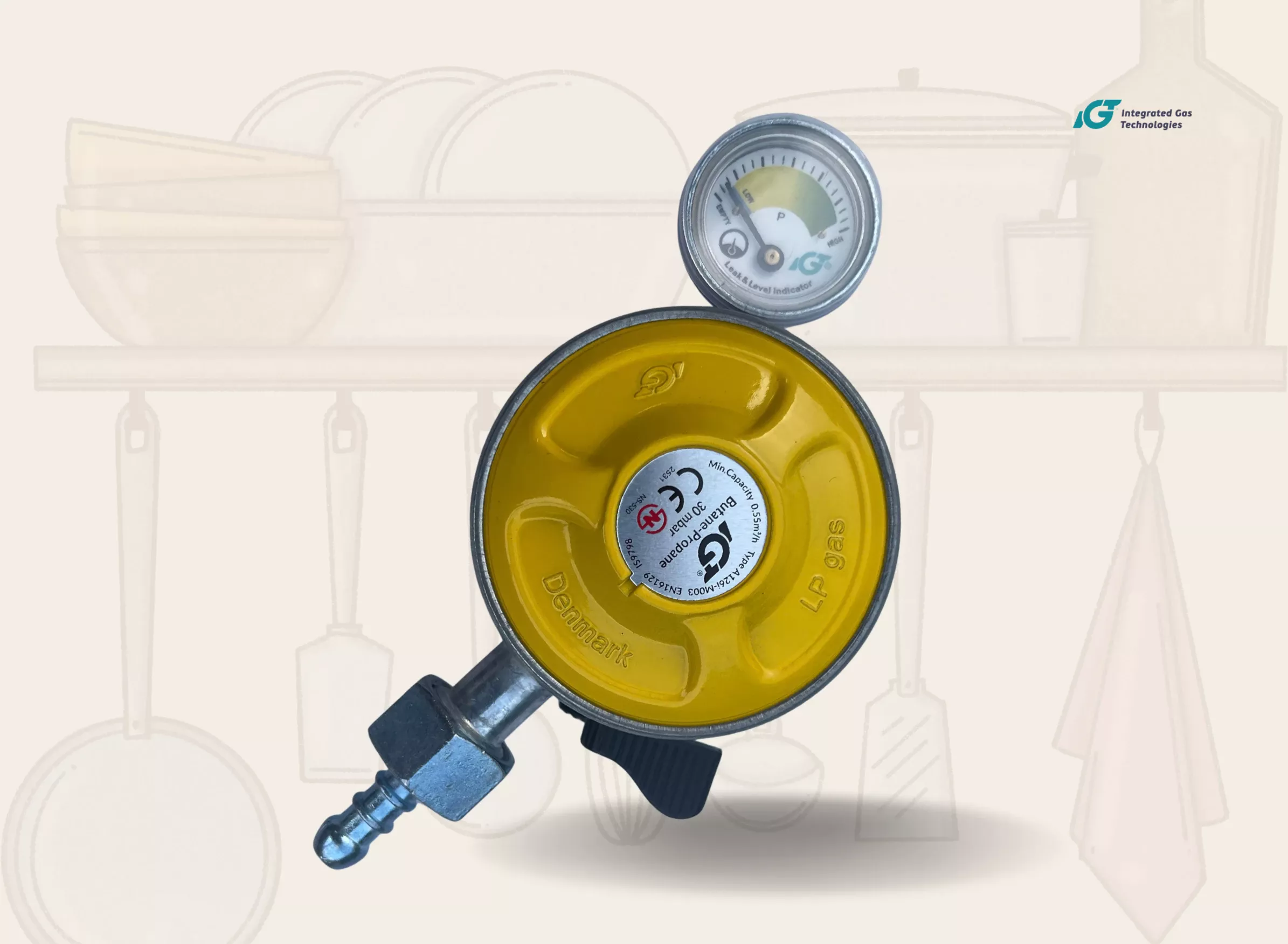
If you have an IGT gas regulator and the leak was caused by a hose rupture or disconnection, the automatic excess-flow shut-off may have already closed the gas supply. But always close the cylinder valve manually as well — belt and suspenders.
Do not try to disconnect the regulator from the cylinder during an emergency. Just close the valve and leave.
Step 5: Evacuate Everyone from the House
Get every person out of the house immediately — family members, children, elderly relatives, guests, domestic helpers, everyone. Move to an open area at least 10 metres from the building. Do not re-enter the house for any reason until the gas has fully cleared.
If you have pets, take them out too. LPG affects animals just as it affects humans.
Step 6: Wait at Least 15 Minutes Before Re-Entering
With all doors and windows open and the cylinder valve closed, the accumulated gas will gradually dissipate. Wait at least 15 minutes before anyone re-enters the house.
When you do re-enter, sniff carefully. If you still smell gas, leave again and wait longer. The rotten-egg smell of mercaptan is your indicator — if you can still smell it, gas is still present.
Step 7: Identify and Fix the Cause Before Using Gas Again
Once the gas has cleared, do not simply reconnect and resume cooking. You need to identify what caused the leak and fix it:
- Check the hose — look for cracks, holes, rodent bite marks, or disconnected ends
- Check the clamps — are they tight? Rusty? Have they slipped?
- Check the regulator connection — is it properly seated on the cylinder valve?
- Check the stove valves — were any burner knobs partially open?
- Run a leak test — use the manometer or soap water method to confirm the entire system is sealed before cooking again
If you cannot identify the cause, do not use the gas system. Call a qualified technician or contact IGT Nepal support for guidance.
What NOT to Do During a Gas Leak (Common Mistakes)
- ❌ Do NOT use a match or lighter to "check where the gas is coming from" — this is the single most dangerous thing you can do
- ❌ Do NOT turn on the exhaust fan — the switch can produce a spark
- ❌ Do NOT try to move the gas cylinder — just close the valve and leave
- ❌ Do NOT stay in the house to "air it out" — evacuate first, then let ventilation work
- ❌ Do NOT assume the smell will go away on its own — LPG accumulates at floor level and does not disperse easily without active ventilation
How to Prevent Gas Leaks in the First Place
Prevention is always better than emergency response. Follow these practices to minimize gas leak risk:
- Close the cylinder valve after every cooking session — especially at night
- Inspect your gas hose monthly for cracks, stiffness, or rodent damage
- Replace your gas hose every 2 years
- Replace your regulator every 5 years
- Run a leak test every time you change a cylinder
- Upgrade to the IGT gas regulator for automatic excess-flow shut-off protection — it stops gas flow in under 0.1 seconds during a hose rupture, preventing the emergency from happening in the first place
Frequently Asked Questions
How long does it take for leaked LPG gas to clear from a room?
With doors and windows fully open, most accumulated gas disperses within 15 to 30 minutes. However, gas trapped in low spots (under cabinets, in basements) may take longer. Always verify by smell before re-entering.
Can I smell LPG gas if there is a very small leak?
Very small, slow leaks may not produce a noticeable odour, especially in well-ventilated kitchens. This is why regular leak testing with a manometer or soap water is important — it catches leaks your nose might miss.
Should I call the fire department if I smell gas?
If the gas smell is strong and persistent after closing the cylinder valve and ventilating, or if you see any signs of fire, yes — call emergency services immediately. For minor leaks that you can identify and fix (a loose clamp, a partially open stove valve), professional help may not be necessary.