Modern apartment complexes, condominiums, and gated housing societies have become the standard of contemporary living across Kathmandu, Lalitpur, and Bhaktapur. From Sanepa and Dhapakhel to Baluwatar, Maharajgunj, and Hattiban, high-density residential towers house thousands of families. However, cooking with Liquefied Petroleum Gas (LPG) inside multi-story residential buildings introduces unique structural and safety challenges that do not exist in standalone suburban houses.
In a high-rise building, an uncontained gas leak does not just threaten a single room — escaping gas can seep through electrical conduits, service ducts, lift shafts, and stairwells, endangering hundreds of neighbors. This guide delivers essential LPG safety protocols tailored specifically for apartment dwellers in Kathmandu Valley and explains why an IGT automatic gas safety regulator is the ultimate line of defense in shared vertical communities.
The Physics of LPG in High-Rise Architecture
To safely manage cooking gas in an apartment, residents must understand how LPG behaves in enclosed multi-level spaces:
- LPG is Heavier Than Air: Liquid Petroleum Gas (a mixture of propane and butane) has a vapor density of approximately 1.5 to 2.0 times that of air. Unlike lighter natural gas (methane) which rises and disperses through ceiling vents, LPG sinks downward like water.
- Ground & Duct Accumulation: Escaping gas flows along the kitchen floor, pools under modular cabinetry, and flows through pipe penetrations, bathroom drainage shafts, and door thresholds into hallways or lower floor units.
- Elevator Shaft Chimney Effect: Elevator shafts and stairwells create strong atmospheric pressure differentials (the stack effect). Leaked gas drawn into an elevator shaft can be ignited hundreds of feet away by an electrical relay or elevator motor switch.
Top 8 Apartment LPG Safety Rules for Kathmandu Residents
- Never Transport Gas Cylinders in Crowded Passenger Elevators:
When delivery personnel bring a fresh 14.2 kg cylinder to your upper-floor flat, the elevator must be completely unoccupied except for the delivery handler. Better yet, utilize the designated service elevator or external fire staircase. If a minor valve leak occurs inside a small enclosed passenger elevator with four or five passengers, an electrical contact spark from the lift door mechanism could cause catastrophic ignition.
- Ventilation Grilles for Modular Kitchen Cabinets:
Modern Kathmandu apartments feature gorgeous, custom-fitted modular kitchens with seamless wooden or acrylic cabinets. When cylinders are shut inside an unventilated under-counter cabinet, any tiny micro-leak from a loose clamp or aging hose fills the cabinet with dense gas. When someone later turns the cabinet handle, static electricity or a spark from an under-cabinet LED light strip can ignite the trapped pocket. Requirement: Always install perforated metal or plastic ventilation grilles on the cabinet door to allow natural airflow.
- Balcony Placement: Best Practices & Pitfalls:
Many apartment owners choose to place their gas cylinder on an outdoor kitchen balcony and route the pipe inside. While outdoor placement provides excellent natural ventilation, you must follow three critical rules:
- Sun & Rain Protection: Direct sunlight on Kathmandu summer afternoons can heat the cylinder shell above 45°C, causing cylinder internal pressure to skyrocket. Ensure the cylinder is shaded under a canopy or dedicated ventilated steel enclosure.
- Protect Against Window Jamming: Never route a soft rubber pipe through a sliding aluminum window gap. Sliding the window shut against the hose can crush the inner liner or sever the rubber. Always install a rigid copper or brass wall sleeve through the masonry wall.
- Hose Length Limits: International building codes specify that flexible rubber gas hoses should never exceed 1.5 to 2.0 meters. For longer runs from an outer balcony to an interior kitchen island, use rigid seamless copper piping with approved compression fittings.
- Mandatory Flame-Retardant Safety Hoses:
Apartment utility shafts are frequent transit routes for rodents looking for food scraps. An ordinary orange rubber hose can be chewed through by a kitchen rat in minutes while you sleep. High-rise apartment homes must use wire-mesh flame-retardant safety hoses (Suraksha pipes) that rodent incisors cannot penetrate.
- Never Store Spare Cylinders in Basements or Storage Lockers:
Building management bylaws across Kathmandu strictly prohibit storing spare or empty LPG cylinders in basement parking areas, underground storage lockers, or communal stair landings. Because LPG sinks, any leak in an unventilated basement gathers at floor level near hot car exhaust pipes and vehicle starters.
- Install a Gas Leak Detector with Automatic Solenoid or Audio Alarm:
Mount a dedicated LPG sensor on your kitchen wall approximately 20 to 30 cm above the floor level (where sinking LPG collects). Ensure the alarm has a backup battery so it remains active during Nepal Electricity Authority (NEA) load fluctuations or transformer maintenance.
- Verify Emergency Gas Isolation Valves:
Know the exact location of your apartment unit's main gas shut-off point. Every adult and teenager living in the home should know how to turn the regulator switch to OFF in the dark or during a tremor.
- Equip Your Kitchen with a 2 kg ABC Dry Powder Fire Extinguisher:
Do not rely solely on the building's hallway fire hose reels, which use pressurized water. Water should NEVER be sprayed onto an LPG gas fire or cooking oil grease fire — it causes violent boiling explosions. Keep a certified ABC dry chemical powder extinguisher mounted near your kitchen exit.
Why Automatic Shut-Off is Non-Negotiable in Multi-Family Housing
If you live in an isolated farmhouse and experience a gas leak, the consequences may be contained to your home. But in an apartment building with 50 or 100 families living within the same concrete superstructure, fire safety is a collective moral and physical responsibility.
Ordinary standard regulators cannot detect when a hose tears, ruptures, or slips off its nozzle. They continue pumping flammable vapor into your apartment at full line velocity until an explosion or manual shut-off occurs.
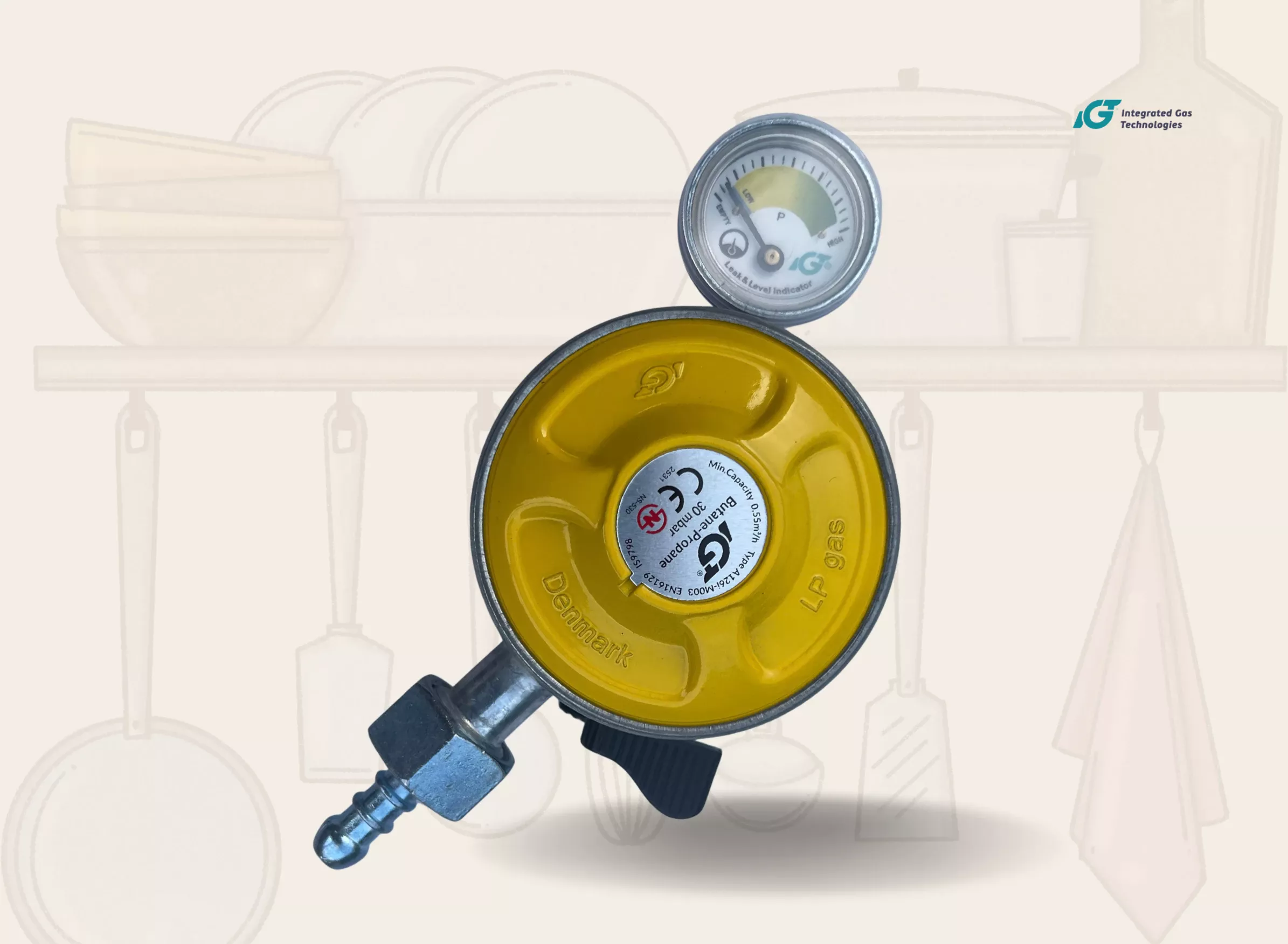
The IGT Denmark Auto-Cut Regulator (A126i-M003) features an internal precision-engineered Excess Flow Valve (EFV). If a hose slips, tears, or is accidentally knocked loose while moving appliances, the internal Danish mechanism senses the sudden surge and snaps shut in less than 0.1 seconds, cutting 100% of the gas supply right at the cylinder neck.
Manometer Testing for High-Rise Apartments
The integrated dual-purpose manometer gauge on the IGT regulator gives apartment residents an instantaneous 2-minute diagnostic tool:
- Turn the IGT regulator switch to ON with the stove burner knobs closed.
- Depress the manometer push-button once to charge the line. The pressure gauge needle rises into the safe green zone.
- Switch the regulator lever back to OFF.
- Observe the needle for 2 minutes. If the needle remains perfectly still, your entire internal line — hose, clamps, joints, and stove valves — is 100% gastight. If the needle drops, gas is slowly escaping somewhere in the line.
Performing this simple check once a month or whenever changing cylinders ensures that your high-rise home remains a safe sanctuary for your family and your neighbors.
Frequently Asked Questions
Does IGT Nepal offer bulk discounts for apartment housing societies?
Yes. IGT Nepal collaborates with housing committees, resident welfare associations (RWAs), and apartment management boards across Kathmandu Valley to provide group purchase packages, safety seminars, and certified installation audits. Contact our corporate desk at igtnepal.com/contact-us.
Is the IGT regulator compatible with standard apartment cylinders in Kathmandu?
Yes. The IGT A126i-M003 regulator fits all standard 25.6 mm compact cylinder valves utilized by Nepal Gas, Siddhartha, Everest, and other registered LPG brands delivered across Kathmandu Valley.
Can earthquake tremors trigger gas leaks in apartments?
Yes. Kathmandu is situated in a seismically active zone. During an earthquake, appliances shift, stretching or severing gas hoses. The IGT regulator's immediate excess-flow shut-off feature automatically isolates the cylinder if a line tears during structural ground movement.